
The comparison in plain language
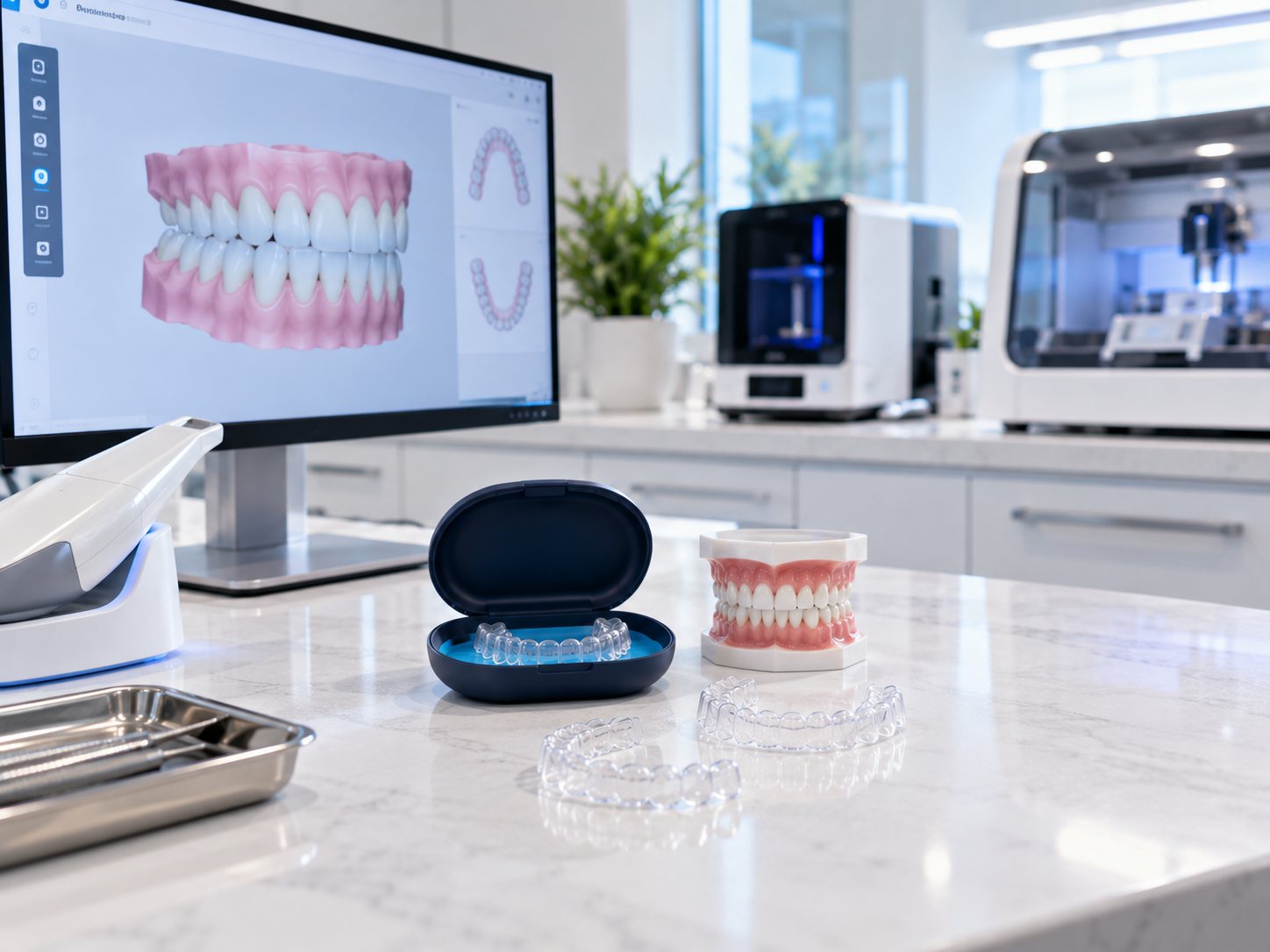
“In-office aligners” describes a production route, not a single brand or a clinical diagnosis. Some digital workflows allow an office to plan treatment and fabricate trays locally; others combine office planning with an outside manufacturer. Ask for the actual software, production method and responsible clinician. [1]
The products and care options
Images identify the options shown. Product photos do not establish local availability or a comparison of treatment results.
What each option describes
Manufacturer-made trays
Production through an external supplier
The treating office uses a prescribed aligner system or production service. Ask who reviews the plan, how trays are ordered and how replacements are obtained.
In-office fabrication
Production at the treating practice
Some platforms support exporting staged models for local fabrication. The specific material and production method should be identified by the office. [1]
What patients usually compare
Production location does not determine clinical quality by itself. Compare the responsibilities, materials and care arrangement for the proposed workflow.
| Compare | Manufacturer-made trays | In-office fabrication |
|---|---|---|
| Planning responsibility | Ask who develops the setup and gives final approval. | Ask the same; local fabrication is not a substitute for an approved prescription. |
| How trays are made | Identify the product and supplier used for the treatment. | Identify the material, equipment and method used to fabricate the trays. |
| Fit and quality checks | Ask how the practice checks the supplied appliance before use. | Ask how production and fit checks are performed before trays are issued. |
| Replacement timing | Ask how long replacement trays usually take for this supplier and office. | Ask what can actually be made locally, and whether new records would be required. |
| Future records | Clarify what clinical records and planning information can be supplied on transfer. | Clarify who retains the setup and fabrication files and what another clinician can receive. |
The production questions patients should ask
Model-based and direct-print workflows differ
A workflow that prints a model and forms a tray over it differs from one that prints the tray itself. Ask the practice which method is proposed and which material and instructions apply. Do not infer the method from seeing a printer in a photograph. uLab describes multiple production options rather than one universal route. [2]
Clarify how changes are authorised
Ask what happens between a progress check and production of revised trays. The office should explain who decides on a change, whether a new scan is needed and how the revised sequence is communicated. The ability to make another tray does not answer whether it is the appropriate next tray.
Keep fabrication and fees separate
Local manufacture may change an office’s workflow, but the patient fee includes more than plastic production. Ask for the full quote, including assessment, planning, monitoring, additional treatment and retention. This guide does not assume either production route costs the patient less.
When either production route may be considered
Where clear aligners are clinically suitable, the clinician can explain why an in-office, external or mixed production arrangement fits the intended treatment. The prescription and review process still need to be clear. Platform capability is not evidence that every case should use that route.
Questions to ask before choosing
- Which planning software, material and fabrication method will be used?
- Who approves each initial or revised treatment setup?
- How are trays inspected and checked for fit before I wear them?
- What can be replaced locally, and when is a new scan needed?
- What are the arrangements for retention, file access and transfer of care?
A few points to clarify
Are in-office aligners always uSmile aligners?
No. uSmile is an aligner product. In-office fabrication is a broader workflow description; ask exactly which product or process the office uses.
Does a digital lab image show equipment available at this clinic?
No. Images on these comparison pages are illustrative. Confirm actual equipment, production arrangements and services with the treating office.
Is a local production route suitable only for small corrections?
Do not infer treatment scope from location of manufacture. Ask the clinician to explain which movements the proposed system can support in your specific case and what alternatives were considered.
Choose the complete proposal
Compare the complete production and care pathway: the prescription, manufacture, inspection, progress review and continuing records. An office-made label is neither a reason to dismiss treatment nor a reason to assume it is preferable.