
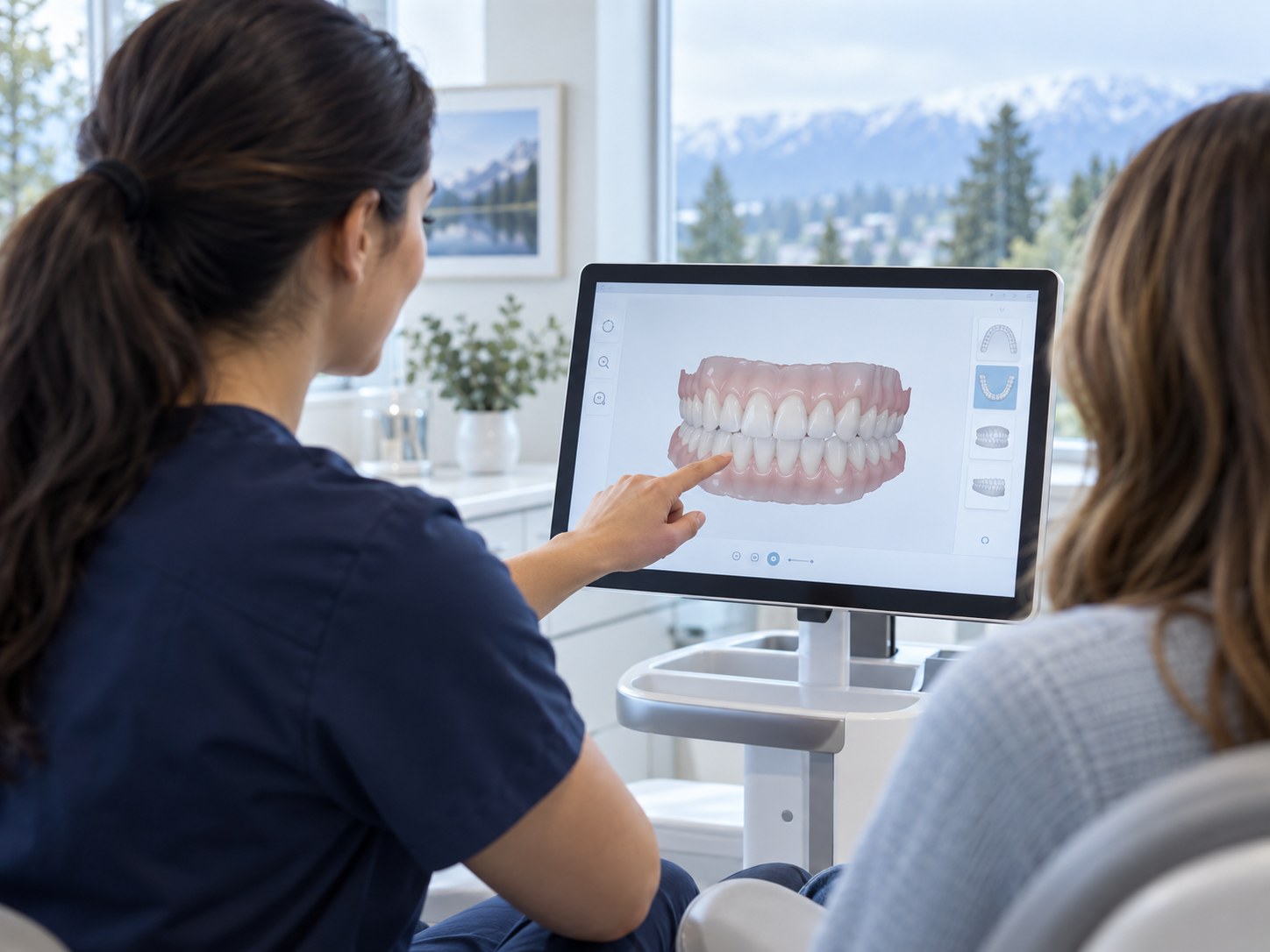
The comparison in plain language
“Remote” can describe a consultation, a progress check or the delivery of trays. Those are not the same service. Some clinician-supervised plans use remote monitoring alongside in-person care. Compare the actual assessment and follow-up arrangements rather than judging a company by a delivery label. [1]
The products and care options
Images identify the options shown. Product photos do not establish local availability or a comparison of treatment results.
What each option describes
In-person / hybrid care
Appointments plus remote checks where appropriate
Ask which visits happen in the office and which reviews can be handled remotely. Remote check-ins may be one part of a supervised plan. [1]
Primarily remote services
Examine the specific service agreement
Ask how records are collected, which clinician accepts responsibility and where in-person assessment or treatment is available when needed.
What patients usually compare
Apply the same questions to any provider. This table does not rate individual companies or assume that all remote services operate alike.
| Compare | In-person / hybrid care | Primarily remote services |
|---|---|---|
| Initial assessment | Ask what is examined in person and which records are required. | Ask who conducts the assessment and how clinically necessary in-person records are arranged. |
| Treating clinician | Identify the dentist or orthodontist responsible for diagnosis and decisions. | Request the same named clinician and a way to contact their care team. |
| Progress checks | Ask how office visits and any remote reviews are scheduled and documented. | Ask who reviews submissions, what feedback you receive and what triggers an office visit. |
| Hands-on procedures | Clarify where attachments, IPR or other prescribed procedures are performed. | Clarify how any needed hands-on procedure is arranged and whether it is included. |
| Continuity and transfer | Ask how to obtain records and arrange care if you move or the plan changes. | Ask the same questions, including access to a clinician if the original arrangement changes. |
Separate convenient communication from clinical responsibility
Know what the initial service includes
A smile photograph, scan appointment and diagnostic examination should not be assumed to mean the same thing. Ask what has been assessed, what remains to be assessed and whether treatment is being proposed before all required information is available.
Ask how an in-person review is triggered
A remote check has to lead somewhere when a question cannot be resolved on screen. Ask who decides when an appointment is needed, where it would happen and who pays for it. This is a continuity question, not an argument against remote communication.
Review access to records and advice
Ask how to contact the responsible clinical team, retrieve your records and request a second opinion. For someone already in treatment, the immediate aim is continuity: take the current trays, the prescribed schedule and available records to the clinician assessing the situation.
Where remote elements may be useful
A clinician may include remote communication or monitoring in an individual treatment plan. Suitability depends on what can be assessed remotely and what requires an examination or procedure. The Canadian Association of Orthodontists emphasises diagnosis and treating-doctor oversight; these remain relevant regardless of where trays are delivered. [1] [2]
Questions to ask before choosing
- Who is the named clinician responsible for my treatment?
- What examination and records are needed before I agree to start?
- How are remote submissions reviewed, and how do I receive clinical instructions?
- Where can I be examined in person if a question cannot be resolved remotely?
- How do I obtain my records or transfer care, and what costs may apply?
A few points to clarify
Is remote monitoring the same as unsupervised treatment?
No. Remote monitoring can be part of clinician-supervised care. The important questions are who is responsible, what is assessed and how in-person care is provided when needed.
Does mailing trays make a treatment unsuitable?
The shipping method alone does not answer suitability. Ask about diagnosis, the prescription, oversight and access to care for the specific service.
I already use a remote service. Can I ask for a second opinion?
Yes. Request your records and bring the trays and current instructions to an assessment. A new clinician will need to review your position before advising on changes or taking over treatment.
Choose the complete proposal
Assess the care arrangement rather than applying a label to the company. A clear proposal identifies the clinician, the records, the review process and the route to hands-on care when required.